My Face Shape Chart
FACE SHAPE CALCULATOR

Face shape calculator: measure your proportions

A face shape calculator should return a working label, the length and width ratios behind that label, and the nearest alternative. Upload one clear, front-facing photo; this face shape calculator measures forehead, cheekbone, jaw, and face length in your browser, then shows which shape the measurements support and what to retest.

The same browser tool can serve as a face type detector, free face shape detector, AI face shape detector, face shape detector app, face shape detection app, or face shape recognizer.

01 / PHOTO

Choose a front-facing photo

Model not loaded

Your photo will appear here

JPG, PNG, or WebP. Use one well-lit, front-facing photo at 600px or larger when possible. Keep your full hairline and jaw visible, use a natural expression, and avoid sunglasses or filters.

03 / CALCULATOR WORKFLOW

How the face shape calculator reaches a label

Read the ratios in order

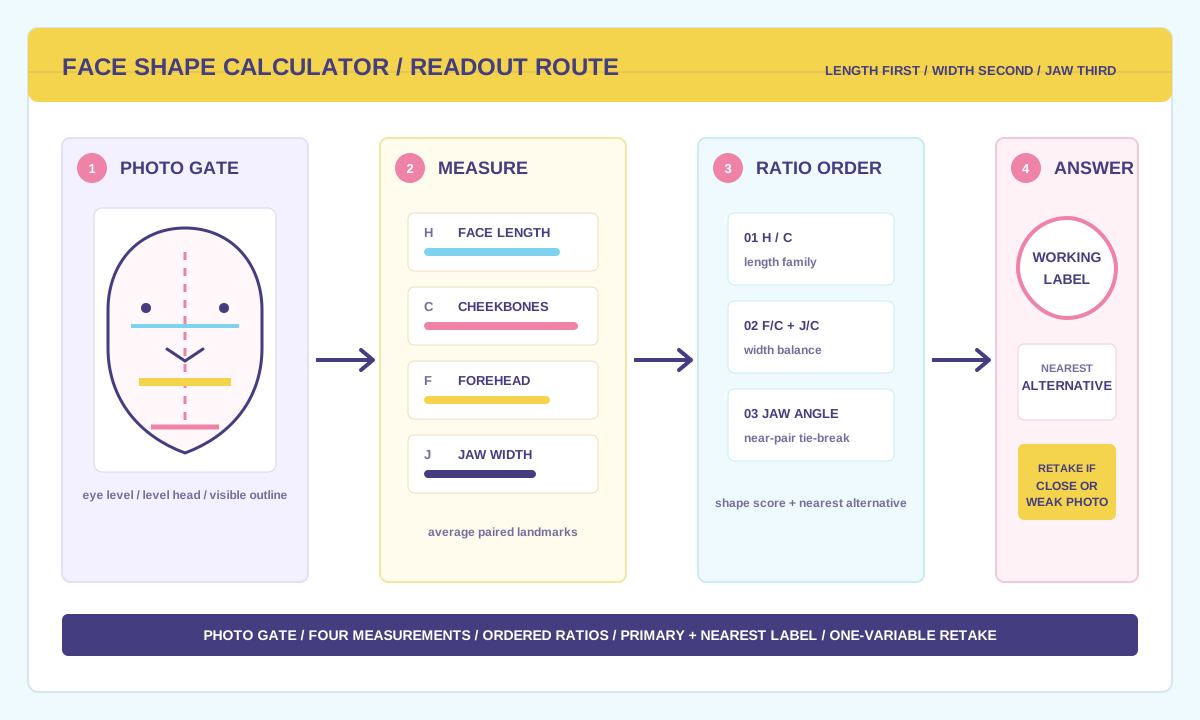
The answer is not the single label alone. The calculator first decides whether the face length reads short, balanced, or long; it then compares three widths, checks the width profile, and uses jaw shape as a tie-breaker. If the first result is close to another shape, keep both labels and change only one photo condition before retaking the measurement.

01

Set a comparison-grade photo

Keep the camera at eye level, the head straight, the expression relaxed, and the hairline and jaw visible. A tilted phone, strong side light, or cropped forehead changes the input before the calculator begins. The detector guide explains the photo conditions that make the readout usable.
02

Read one length and three widths

H runs from the upper face to the chin. C is cheekbone width, F is forehead width, and J is jaw width. The calculator uses cheekbone width as the common reference, so the three visible ratios are H/C, F/C, and J/C. Averaged landmark pairs make one stray point less influential.

03

Follow the same decision order

Start with H/C to place the result in a short, balanced, or long length family. Use F/C and J/C to find the dominant horizontal line. Then check the width profile and jaw angle. Starting with the jaw alone can make a long oval look square, while starting with length alone can hide a strong cheekbone or lower-face width.

04

Keep the nearest alternative

A border result is useful evidence, not a calculation error. Treat the primary label as the best current description and the secondary label as the nearby hypothesis. Retake the photo at the same distance with one condition changed. If the pair stays together, use the mixed-result method instead of forcing one permanent category.

Working answer: [primary shape] with [nearest alternative], based on H/C [number], F/C [number], J/C [number], a [width order] width profile, and a [soft or angular] jaw.
A face shape calculator route showing length, forehead, cheekbone, and jaw measurements leading through ratio checks to a working label and nearest alternative.
Read the measurements first, then use shape and jaw language to explain the calculator result.
Calculator readout order
Readout What it answers How to use it
Length ratio Is the face shorter, balanced, or clearly longer than its cheekbone width? Use it as the first filter. Do not let jaw styling advice override the length family.
Width balance Do the forehead, cheekbones, or jaw dominate the horizontal profile? Use the order to separate upper-heavy, cheek-led, and lower-heavy shapes.
Jaw angle Does the lower outline read softer or more angular? Use it to separate close pairs such as round versus square, not as the whole answer.
Nearest alternative Which category remains plausible after the primary score? Record both. Retake once when the result is close instead of treating the first label as fixed.
Photo quality Did angle, exposure, size, cropping, or expression weaken the input? Withhold the label when a blocking warning appears; use a warning note only as a reason to retest.

The percentage shown with a result describes the strength of the rule match under this site's fixed model; it is not a probability that a stranger would choose the same word. For a second observation, compare the [face shape chart](/face-shape-chart) and keep the [face symmetry test](/face-symmetry-test) separate: symmetry checks whether paired features repeat, while this calculator compares overall length and width. The [eye shape detector](/eye-shape-detector) records lid opening, upper-lid structure, corner tilt, and spacing separately. The [golden ratio face test](/golden-ratio-face-test) shows how to lock a distance pair and calculation direction without turning the number into a beauty score.

04 / METHOD

How it works

Transparent rules
A

Landmarks & ratios

Once the model returns facial landmarks, three pairs are averaged for each horizontal width. This reduces the effect of one unstable point.

H = d(10, 152) C = avg cheekbone pairs F = avg forehead pairs J = avg jaw pairs

d(a, b) = sqrt((x_a - x_b)^2 + (y_a - y_b)^2)

H / C Face length / cheekbone width F / C Forehead / cheekbone width J / C Jaw / cheekbone width Angle Average left and right jaw-corner angle
B

Shape rules

Seven shape profiles are scored from length, width balance, and jaw angle. The highest score is shown with the nearest alternative.

OblongLong face + even widths
OvalModerate length + tapered jaw
RoundShort ratio + soft jaw
SquareShort ratio + broad angular jaw
HeartForehead wider than jaw
DiamondCheekbones dominate both ends
TriangleJaw wider than forehead

Point indices come from MediaPipe Face Mesh's official facial-contour connection map. The model and runtime load from public CDNs / public model storage; this page has no backend upload endpoint. Read how to interpret a result, compare the chart, or review the privacy policy.

05 / FACE SHAPE QUIZ

What makes a face shape quiz useful?

A useful face shape quiz gives you a working label plus the measurements behind it. Upload one clear, front-facing photo, then check face length, forehead width, cheekbone width, and jaw width before treating the result as a styling starting point.

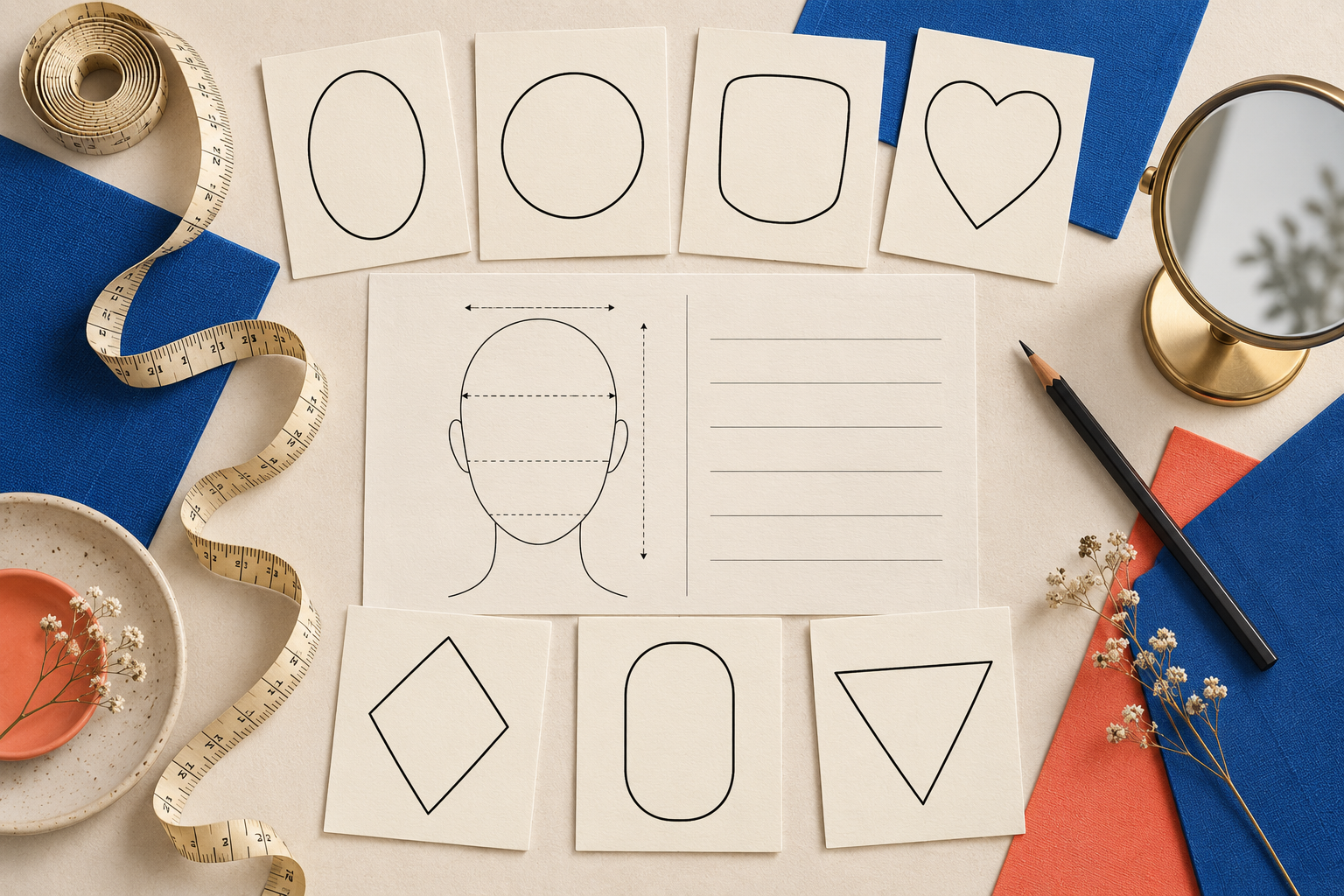
Measuring tape, mirror, measurement sheet, and seven blank face-shape outline cards arranged for a face shape quiz.
Record the same lines in the same conditions before comparing labels.