
Lock the numerator, denominator, direction, and photo evidence before comparing a facial distance pair with phi; report geometry without a beauty grade. Open the detector
golden ratio face test
A golden ratio face test measures selected facial distances, fixes the numerator and denominator before comparing their ratio with φ, and reports uncertainty instead of a beauty verdict. The conventional value is approximately 1.618. A useful test keeps the original landmarks, image units, calculation direction, and visibility notes, because changing the order of a pair can make the same face look close to either 1.618 or 0.618.
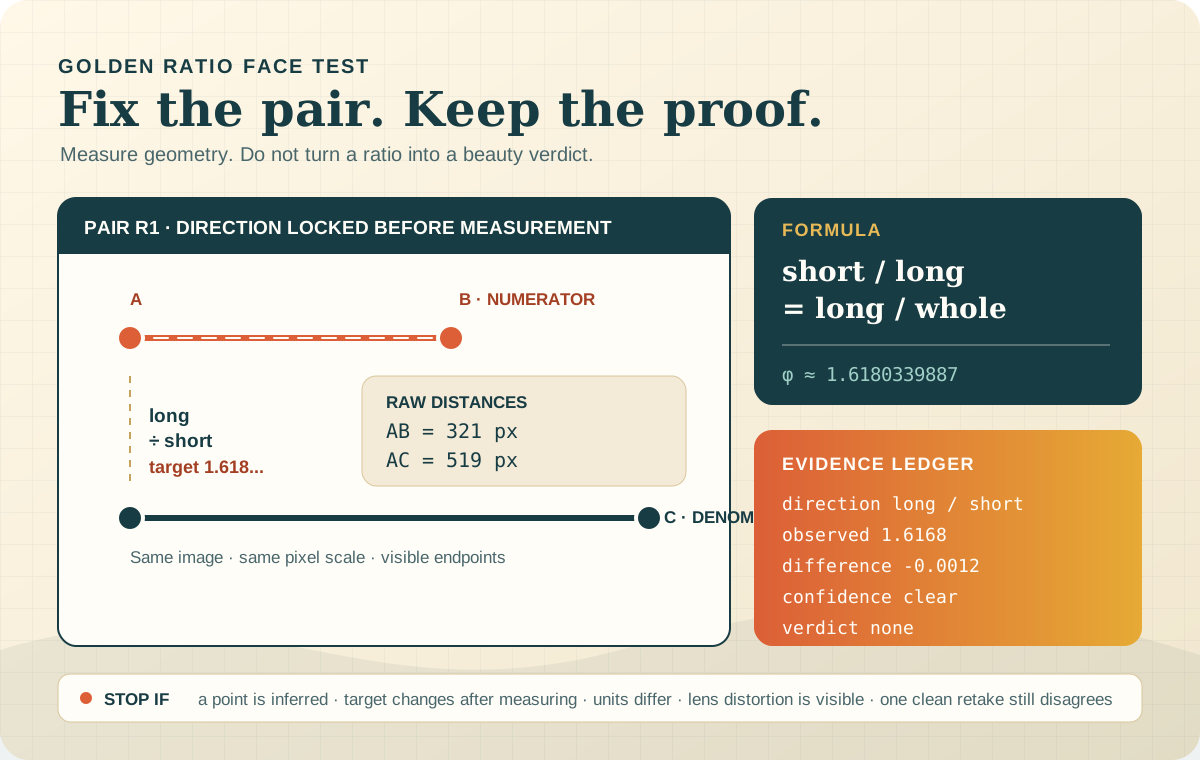
Use a ratio test, not a beauty test
The golden ratio is a mathematical relationship. In its conventional form, the shorter part of a line relates to the longer part in the same way the longer part relates to the whole:
```text
short part / long part = long part / whole line
φ = (1 + √5) / 2 ≈ 1.6180339887
```
That equation can describe a pair of constructed line segments. It does not decide whether a face is attractive, healthy, normal, or suitable for a procedure. A 2023 review titled “The golden ratio—dispelling the myth” found no convincing evidence that the ratio defines ideal human proportions or that it should determine facial aesthetic or reconstructive decisions. A systematic review of natural facial esthetics similarly found no significant association between the golden proportion and facial evaluation scores across the groups it examined.
This page therefore treats a golden ratio face test as a geometry check. It can tell you whether two recorded distances sit close to the selected mathematical target. It cannot tell you what the result means about your appearance.
Lock the pair before calculating
Every ratio needs two named landmarks and a fixed direction. Decide both before you take a measurement.
Use one of these two equivalent forms:
| Direction | Formula | Target | Best use |
|---|---|---|---|
| Longer ÷ shorter | long distance / short distance | 1.618... | When the larger distance is placed first |
| Shorter ÷ longer | short distance / long distance | 0.618... | When the smaller distance is placed first |
Never swap the pair after seeing which order looks closer to the target. That turns the calculation into a search for a preferred result. A pair measured as 38 and 24 pixels gives approximately 38 / 24 = 1.5833 in the long-over-short direction and approximately 24 / 38 = 0.6316 in the reverse direction. Both describe the same two distances; only one matches the direction you declared before measuring.
Write the pair like an audit trail:
```text
Pair ID: R1
Landmark A: left outer eye corner
Landmark B: left mouth corner
Numerator: AB distance
Denominator: AC distance
Direction: AB / AC, compare with 1.618
Image units: pixels in the original image
Visibility: both points clear in frame 1 and frame 2
```
The landmark names and direction belong in the result. “Golden ratio: 97%” does not.
Choose landmarks that can actually be seen
Popular face-ratio pages use different points and different formulas. Two tools can therefore produce different numbers while both claim to measure the golden ratio. Before comparing results, check that they use the same numerator, denominator, landmark definitions, image scaling, and direction.
For a repeatable cosmetic photo exercise, use only points you can identify without guessing through hair, shadow, makeup, a filter, or a turned face. Examples include the visible outer eye corners, the visible mouth corners, the nose base, the chin outline, and the widest visible face line. A hairline is harder to place when hair, lighting, or a receding line obscures the transition. Mark it inferred if you decide to use it.
Do not combine:
- a point placed on makeup with a point placed on skin;
- a landmark from one photo with a denominator from another;
- a pixel distance from a cropped image with a distance that assumes an uncropped frame;
- a left-side landmark with a right-side landmark unless the formula explicitly calls for that comparison;
- a near-camera point with a far-camera point and then treat the result as though both had the same scale.
Distances within one undistorted image can be compared in pixels. The ratio remains unitless because the same unit cancels. That does not remove perspective error. A close phone lens can enlarge the nose relative to the ears, and a tilted head can foreshorten one side of the face.
Pass the photo gate first
Use a photograph that gives the geometry a fair chance:
- face the lens with the nose centered and both sides visible;
- keep the camera at about eye level;
- use soft, even front light with no hard shadow crossing a chosen point;
- keep a neutral expression with the mouth closed and relaxed;
- remove glasses if their frame hides a landmark;
- keep hair away from the eye corners, mouth corners, and chin;
- turn off beauty filters and lens effects that alter the outline;
- leave enough frame around the head that no selected point sits at the edge.
Then make a visibility ledger with one row per landmark. Mark each point clear, inferred, or hidden. If either endpoint of a chosen pair is hidden or inferred, mark that pair unresolved. A ratio built from two guessed points is a styled guess, not a measurement.
Calculate one pair at a time
Suppose the declared pair is the straight image distance between points A and B as the numerator and between points A and C as the denominator. Measure each in the same original-resolution image with the same coordinate convention.
```text
distance = √((x₂ − x₁)² + (y₂ − y₁)²)
observed ratio = numerator distance / denominator distance
signed difference = observed ratio − 1.6180339887
absolute relative difference = |signed difference| / 1.6180339887
```
Keep the signed difference. It shows whether the observed ratio is above or below the declared target. If your pair is authored in short-over-long form, use 0.6180339887 as the target instead. Do not mix the two targets in one row.
Here is a completed example using invented landmark coordinates for demonstration only:
```text
A = (400, 500)
B = (500, 500) → AB numerator = 100 pixels
C = (400, 660) → AC denominator = 160 pixels
Observed ratio = 100 / 160 = 0.6250
Declared target = 0.6180...
Signed difference = 0.006966...
```
The example does not claim that those points form a facial golden ratio. It shows how to keep the arithmetic inspectable. If you measure by clicking a browser image, write down the displayed pixel coordinates rather than only the final ratio.
Preserve the measurement trail
A result becomes useful when another view of the same photo can reproduce it. Use a compact table with no composite score:
| Field | What to record | Why it matters |
|---|---|---|
| Pair ID | A short label such as R1 | Keeps rows separate |
| Endpoint A | Feature and side | Prevents silently moving the landmark |
| Endpoint B | Feature and side | Makes the numerator testable |
| Endpoint C | Feature and side for the denominator | Prevents mixing unrelated distances |
| Direction | Long ÷ short or short ÷ long | Fixes the target |
| Raw distances | Pixels or another same-frame unit | Allows recalculation |
| Observed ratio | Numerator ÷ denominator | Shows the direct result |
| Signed difference | Observed − declared target | Preserves direction from the target |
| Confidence | Clear, uncertain, or unresolved | Keeps uncertainty visible |
| Retake comparison | Same, changed, or not repeatable | Tests photo sensitivity |
Do not average unrelated pairs into one “golden ratio face score.” A single average hides whether one landmark moved, one ratio was reversed, or one photo had more perspective distortion than another. Each pair answers a separate question.
Read difference without turning it into a grade
A ratio that is numerically close to φ is close to φ for that declared pair in that photograph. It is not a pass. A ratio farther away is not a fail. There is no validated universal cut point at which a face-ratio difference becomes beauty, health, symmetry, or a treatment recommendation.
Record the result in plain language:
```text
Pair R1: observed 1.604, declared target 1.618, signed difference −0.014.
Photo confidence: uncertain because the left mouth corner was partly shadowed.
Repeatability: not tested.
Interpretation: the recorded distance pair is close in this frame; no beauty inference.
```
If you want a descriptive band, define it before measuring and label it as your own comparison rule. For example, you might say that you will call a pair “near the declared target for this test” when the absolute relative difference is within 2%, but that threshold is an arbitrary test convention, not a scientific definition of facial beauty. State that boundary beside the result.
Do not copy a tool's score model
Current face-ratio tools can use hundreds of landmarks, different numbers of ratios, percentage deviations, and proprietary harmony scores. Similar-looking scores may not share a formula. Before using one, inspect what it actually reports.
Ask four questions:
- Which exact landmarks define each numerator and denominator?
- Is the target
1.618,0.618, or another number? - Is the displayed percentage a relative difference, a transformed score, or a rank?
- Does the result combine multiple ratios, and if so, with what weights?
If a page does not answer those questions, its “golden ratio face test” cannot be reproduced from the page alone. A polished score is not stronger evidence than a visible calculation.
Check repeatability with one controlled change
Take a second photo with one change only. Good choices are moving the camera to eye level, turning the face squarely toward the lens, clearing one strand of hair, or replacing side light with even front light.
Recalculate the same pairs in the same declared directions. Then classify each row:
- Repeatable: the landmark visibility stays clear and the ratio remains close enough that the descriptive result does not change;
- Photo-sensitive: the ratio moves materially after the camera or visibility correction;
- Unresolved: one endpoint cannot be placed confidently in either image;
- Input error: the numerator, denominator, units, or target changed between calculations.
Do not “fix” a pair by moving its endpoint until it looks more golden. If a landmark is ambiguous, record the ambiguity and try a better photo.
Know when a face ratio test should stop
Stop the cosmetic calculation when:
- the head is turned enough that paired distances have different perspective;
- the lens visibly distorts the center of the face;
- a chosen endpoint is hidden by hair, glasses, makeup, shadow, or crop;
- a filter changes the jaw, nose, eyes, or skin boundary;
- the numerator and denominator do not come from the same image scale;
- the target is switched after measurement;
- several pairs cannot be reproduced after one clean retake.
Also stop if a facial feature change is sudden, painful, inflamed, or affects breathing, vision, speech, swallowing, or movement. A website ratio cannot assess the cause of a medical symptom.
What the research can and cannot support
Research on facial proportions is not a simple endorsement of a beauty formula. One experimental paper describing “new golden ratios” reported preferred-looking proportions near average facial proportions, not proof that the classical φ relationship explains attractiveness across people. A systematic review of natural facial esthetics found that its included faces did not follow the golden proportion and found no significant association with facial evaluation scores across the examined groups. A critical review additionally noted that well-known facial masks have narrow source samples and cannot stand in for global populations.
Those findings do not prove that no person can have a distance pair near φ. They show why a single ratio should not be promoted as a universal aesthetic standard. Human faces vary within and across populations, photographs introduce distortion, and attractiveness judgments involve context beyond a static geometric pair.
The responsible conclusion is narrow: you can calculate a declared pair and describe how close it sits to a declared mathematical target. You cannot convert that calculation into a universal beauty verdict.
Continue with other face measurements
Use the [face shape detector](/face-shape-detector) for a separate length-and-width workflow. The [facial thirds test](/facial-thirds-test) maps vertical shares, while the [face symmetry test](/face-symmetry-test) compares corresponding features. The [eye shape detector](/eye-shape-detector) keeps lid, crease, corner, and spacing observations separate. If the question is about styling rather than proportion, begin with the [face shape chart](/face-shape-chart) and [what is my face shape](/what-is-my-face-shape).
golden ratio face test questions
What is the golden ratio face test?
It is a photo-based exercise that compares a declared facial distance pair with the mathematical golden ratio, approximately 1.618. A reproducible version records the endpoints, numerator, denominator, units, calculation direction, and landmark confidence.
Does the golden ratio prove facial beauty?
No. Reviews of facial aesthetics have not established the golden ratio as a universal standard for attractive or ideal faces. A numerical match describes geometry for one declared pair; it does not measure beauty, health, or worth.
Should I calculate long divided by short or short divided by long?
Either can work if you declare the direction before measuring. Long divided by short compares with approximately 1.618. Short divided by long compares with approximately 0.618. Do not switch forms after seeing which result looks closer.
Why do different golden ratio calculators show different results?
They may use different landmarks, image normalization, ratio directions, number of pairs, aggregation rules, or score transformations. A score is reproducible only when those inputs and formulas are visible or known.
Is one photo enough for a stable result?
One clear photo can support a provisional pair-level observation. A second photo with one controlled correction is better for testing photo sensitivity. A photo with hidden landmarks or a turned head should be marked unresolved instead of averaged with a clearer image.
Can face-ratio differences diagnose a medical condition?
No. This is a cosmetic photo exercise, not a clinical assessment. Sudden swelling, pain, injury, breathing difficulty, vision change, or movement change needs appropriate professional assessment.
The best golden ratio face test produces a reproducible geometry ledger, not a beauty grade. Fix the pair, preserve the raw evidence, mark uncertainty, and treat the ratio as one narrow measurement whose limitations remain visible.